
Diastasis Recti Repair in Mexico
Restore Your Core — Save 65–75%
Expert diastasis recti repair performed by board-certified surgeons at accredited hospitals in Tijuana, Guadalajara & Puerto Vallarta. Whether post-pregnancy or post-bariatric, we restore abdominal wall function and aesthetics — at a fraction of U.S. costs.
Get a Free Quote 💬 WhatsApp UsDiastasis and Abdominal Wall Repair in Mexico
Board-certified repair of diastasis recti (rectus plication) for international patients — restoring core strength and abdominal contour — at accredited hospitals with a bilingual team.
- Rectus plication
- Combines with hernia repair
- Minimally invasive options
- Board-certified surgeon
- Accredited hospitals
- Bilingual coordinator
Request Your Free Quote
Board-certified surgery in Mexico. A bilingual coordinator replies within one business day — no obligation.
🔒 Your information is private and used only to prepare your quote.
Thank you!
We’ve received your request. Dr. López’s team will contact you within one business day.
What Is Diastasis Recti?
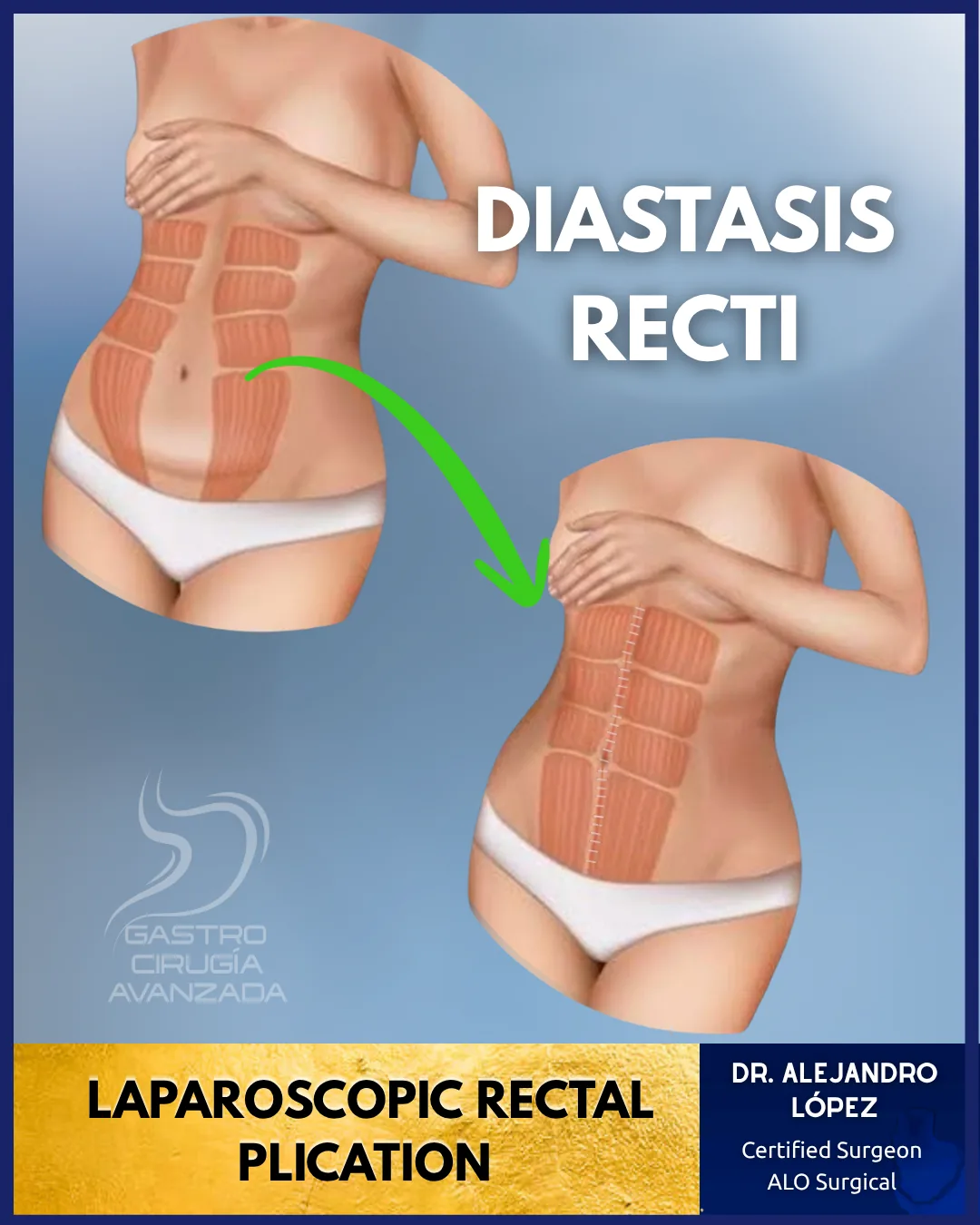
Diastasis recti (also called diastasis rectus abdominis) is the separation of the two parallel rectus abdominis muscles — the "six-pack" muscles — along the midline of the abdomen. The gap forms when the connective tissue (linea alba) that joins them stretches and weakens beyond its natural capacity.
This is not a hernia, but it significantly weakens the abdominal wall, causing functional problems (back pain, poor posture, pelvic floor dysfunction) and aesthetic concerns (the characteristic "belly pooch" that doesn't improve with exercise).
The most common cause. The expanding uterus stretches and separates the linea alba. Affects up to 66% of women in the third trimester.
Rapid weight loss after bariatric surgery commonly reveals or worsens diastasis recti. Often repaired alongside a panniculectomy or tummy tuck.
Heavy lifting, obesity, or repeated intra-abdominal pressure can separate the muscles over time — even in men.
About 40% of cases involve men — typically linked to obesity, heavy physical labor, or prior abdominal surgeries.
How Is It Diagnosed?
Diastasis recti is diagnosed by physical examination and confirmed with abdominal ultrasound or CT scan. The severity is measured by the inter-rectus distance (IRD):
| Grade | Gap Width | Clinical Significance |
|---|---|---|
| Mild | 2–3 cm | Functional weakness; may respond to physical therapy first |
| Moderate | 3–5 cm | Significant abdominal wall dysfunction; surgical repair recommended |
| Severe | >5 cm | Surgery required; often combined with hernia repair or abdominoplasty |
Signs You May Have Diastasis Recti
Physical Symptoms
- A visible "ridge" or bulge running down the center of the abdomen when you crunch or lift
- Persistent belly pooch despite diet and exercise
- Lower back pain or pelvic girdle pain
- Poor posture — difficulty standing straight
- Feeling of abdominal weakness or "coning"
- Urinary stress incontinence (leaking with coughing/sneezing)
Functional Impact
- Inability to perform core exercises without worsening the gap
- Difficulty lifting moderate weights
- Digestive issues (bloating, constipation)
- Hip or sacroiliac joint pain
- Reduced quality of life and body confidence
- Traditional sit-ups and crunches make it worse — not better
Who Is Most Affected by Diastasis Recti?
Diastasis recti can affect anyone, but it is far more common in three groups:
Postpartum women
The most common cause — the growing uterus stretches and separates the linea alba, affecting up to two-thirds of women in the third trimester.
After major weight change
Significant weight gain or rapid loss (including after bariatric surgery) can stretch and weaken the abdominal midline.
Athletes with poor form
Repeated, incorrectly performed core exercises can worsen or reveal a separation instead of strengthening the wall.
How Is Diastasis Recti Repaired?
Diastasis repair involves bringing the separated rectus muscles back together and reinforcing the midline with sutures and/or synthetic mesh. The approach depends on the severity and whether other procedures are combined.
| Approach | Best For | Incision | Notes |
|---|---|---|---|
| Laparoscopic Repair | Mild-moderate diastasis without excess skin | 3–4 small ports (5–12 mm) | Fastest recovery; minimal scarring; no skin removal |
| Open (Mini-Abdominoplasty) | Moderate diastasis + lower skin laxity | Low horizontal bikini-line incision | Allows limited skin/fat removal along with repair |
| Full Abdominoplasty + Repair | Severe diastasis + significant excess skin (post-bariatric/post-pregnancy) | Hip-to-hip bikini-line incision | Complete abdominal wall restoration; best aesthetic result |
Step-by-Step: Laparoscopic Diastasis Repair
You are comfortably asleep. Procedure takes 60–120 minutes depending on complexity.
3–4 small ports placed. A HD camera provides detailed visualization of the abdominal wall from the inside.
The rectus muscles are brought together using permanent sutures along the entire length of the midline.
For wider gaps (>4 cm), a lightweight synthetic mesh is placed to reinforce the repair and prevent recurrence.
Ports closed with absorbable sutures. A compression garment is applied immediately — worn 4–6 weeks.
Diastasis Repair: Mexico vs. United States
In the U.S., diastasis repair ranges from $8,000–$20,000+ depending on whether it's laparoscopic or combined with abdominoplasty. Our all-inclusive packages in Mexico offer the same surgical quality at dramatically lower cost.
| Procedure | 🇺🇸 United States | 🇲🇽 Mexico (GCA) |
|---|---|---|
| Laparoscopic Repair Only | $8,000–$12,000 | $3,000–$4,500 |
| Repair + Umbilical Hernia | $10,000–$15,000 | $4,000–$6,000 |
| Repair + Mini-Abdominoplasty | $12,000–$18,000 | $5,000–$7,500 |
| Repair + Full Abdominoplasty | $15,000–$25,000 | $6,500–$9,500 |
3 Locations Serving U.S. & Canadian Patients
🏙️ Tijuana, Baja California
20 minutes from San Diego International Airport (SAN). No long flight required — ideal for patients from California, Arizona, Nevada, and the Pacific Northwest. Cross-border care at internationally accredited facilities.
🌆 Guadalajara, Jalisco
Mexico's medical capital with direct flights from 30+ U.S. cities. Our main surgical hub — the largest volume of diastasis and abdominal wall cases. Internationally trained surgical teams with state-of-the-art laparoscopic equipment.
🌴 Puerto Vallarta, Jalisco
Recover beachside on Mexico's Pacific Coast. Direct flights from Los Angeles, Phoenix, Houston, and Seattle. Perfect for patients who want to combine surgical recovery with a relaxing resort-style environment.
Recovery Timeline
| Timeframe | Laparoscopic | Open / With Abdominoplasty |
|---|---|---|
| Day 1–2 | Hospital stay. Walking same day. Mild soreness. | Hospital stay 2 nights. Drains placed. More soreness. |
| Days 3–7 | Light activity. Most ready to fly home by day 7. | Rest required. Compression garment 24/7. Limited walking. |
| Week 2–3 | Return to desk work. No heavy lifting. | Swelling and bruising normal. Short walks encouraged. |
| Week 4–6 | Return to most activities. Core work restricted. | Most daily activities resumed. Drains removed (if placed). |
| Week 6–12 | Full activity including core training. | Full recovery. Scar fading begins. |
Are You a Candidate?
- Inter-rectus gap >2.5 cm confirmed by ultrasound
- Persistent back pain, core weakness, or urinary issues
- Post-pregnancy women (at least 6 months after delivery)
- Post-bariatric patients who have reached stable weight
- Non-smokers or willing to quit 4+ weeks before surgery
- BMI under 35 (higher BMI evaluated individually)
- Currently pregnant or planning pregnancy soon
- Less than 6 months post-partum
- Weight not yet stable after bariatric surgery
- Active smoking (increases complication risk)
- Uncontrolled diabetes or hypertension
- Mild diastasis (2–2.5 cm) — PT may be tried first
Often Combined or Related
Frequently occurs at the diastasis gap. Often repaired in the same operation.
Mesh-based repair of abdominal wall defects — shares surgical principles with diastasis repair.
Gallbladder removal — commonly needed by post-bariatric patients alongside body contouring.
Abdominal wall issues often coexist with hiatal hernias in post-bariatric patients.
Diastasis Repair in Mexico — FAQ
Ready to Rebuild Your Core?
Send us your abdominal ultrasound or CT report and photos. Our surgeon evaluates every case personally — free, with no obligation to travel.
Request Free Evaluation 💬 WhatsApp a Coordinator