
A SURGEON’S GUIDE
GERD & Hiatal Hernia Surgery
How the operation is chosen — and why technique, not just the name of the procedure, decides the outcome.
By Dr. Alejandro López Ortega, MD, FACS · Fellow of the American College of Surgeons, also certified by the Mexican Council of General Surgery · FACS profile · verify credentials
Narrative review · 17 references · 12-min read
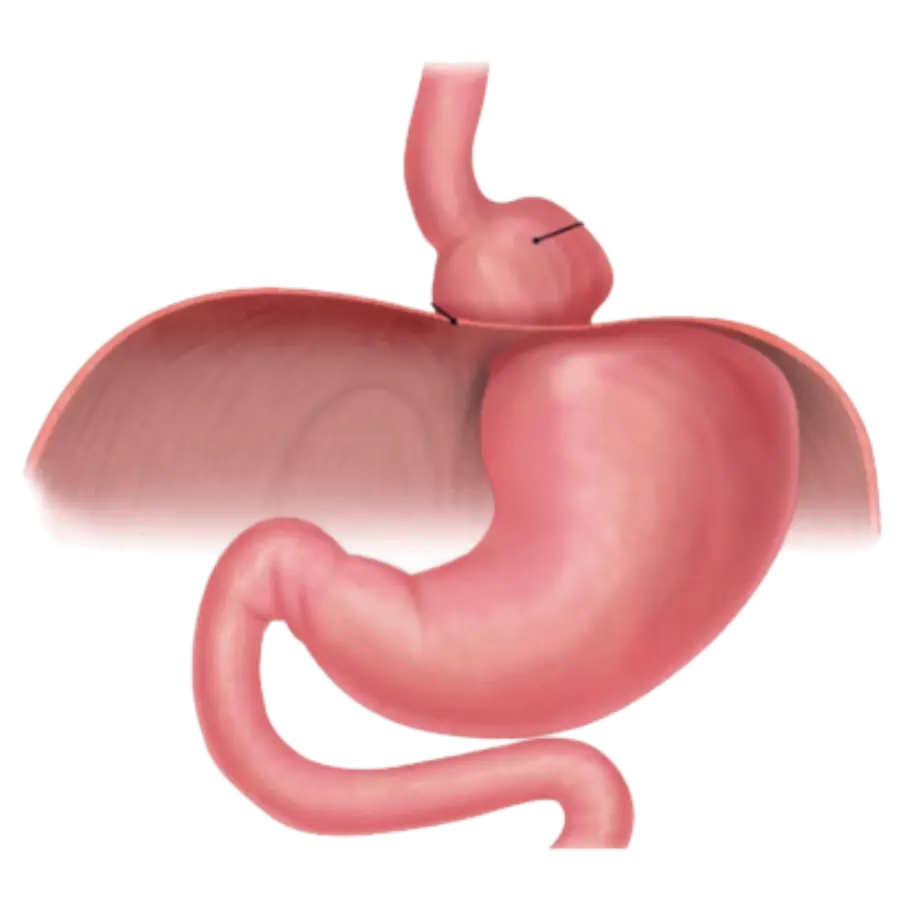
Do you really need surgery for reflux?
Antireflux surgery is not a single operation. The right choice depends on your tests, your anatomy, how your esophagus moves, the type of hernia, your weight and any previous surgery — not on a one-size-fits-all package.
This guide explains, in plain language backed by current evidence, how Dr. López decides between Nissen, Toupet or Dor, when a gastric bypass makes more sense, and why the surgeon’s experience changes the result. If you prefer, send your studies and get a direct opinion on your case.
- Success depends on three things: objective diagnosis, the right procedure, and technical execution.
- Nissen, Toupet and Dor have broadly comparable long-term results; Toupet causes less difficulty swallowing when motility is weak.
- Robotic vs laparoscopic: no difference in complications or recurrence across 550,175 patients — the robot’s value is technical, in complex cases.
- With obesity or a failed fundoplication, a gastric bypass may be the better antireflux operation.
Get Dr. López’s opinion
Send your case — under a minute, in two short steps.
Request Your Free Quote
Board-certified surgery in Mexico. A bilingual coordinator replies within one business day — no obligation.
🔒 Your information is private and used only to prepare your quote.
Thank you!
We’ve received your request. Dr. López’s team will contact you within one business day.

1. Is antireflux surgery a single operation?
No. The operation is chosen according to demonstrated pathophysiology, anatomy, esophageal motility, hernia type, BMI, and previous surgery — no single option is superior for everyone.
Antireflux surgery should not be viewed as a single operation for every patient with heartburn. Indication and procedure selection should respond to demonstrated pathophysiology, gastroesophageal junction anatomy, esophageal motility, hiatal hernia characteristics, body mass index (BMI), previous operations, and reconstructive complexity. Contemporary guidelines accept either complete or partial fundoplication and either laparoscopic or robotic approaches, without establishing universal superiority of one option.
The central thesis of this guide is that procedure selection and technical execution are inseparable. A technically inadequate fundoplication is not corrected merely by changing Nissen to Toupet, adding mesh, or using a robotic platform; excellent technique likewise cannot compensate for an incorrect indication.
2. How is GERD confirmed before surgery?
With objective evidence: Los Angeles grade B, C, or D esophagitis, biopsy-proven Barrett’s esophagus, peptic stricture, or esophageal acid exposure above 6% on monitoring. Surgery should never be used as a diagnostic test.
Lyon Consensus 2.0 considers Los Angeles grade B, C, or D esophagitis, biopsy-proven Barrett’s esophagus, and peptic stricture conclusive evidence of GERD. Esophageal acid exposure time (AET) >6% represents pathological acid burden; during prolonged wireless monitoring, AET >6% on at least two days supports a conclusive diagnosis. AET <4% with positive reflux-symptom association is compatible with reflux hypersensitivity, whereas AET 4–6% requires additional context.
The ACG guideline recommends endoscopy for dysphagia or alarm features and reflux monitoring off therapy when GERD is suspected but not objectively established. Surgery should not be used as a diagnostic test.
3. Why is manometry needed before surgery?
To characterize how the esophagus moves and to exclude major motor disorders, such as achalasia, before choosing the type of fundoplication.
High-resolution manometry (HRM) is essential before antireflux surgery to characterize motility and, importantly, exclude major motor disorders. Chicago Classification v4.0 defines conclusive ineffective esophageal motility (IEM) as >70% ineffective swallows or ≥50% failed swallows; absent contractility requires 100% failed peristalsis. In a patient with dysphagia and a normal or borderline IRP, achalasia should remain in the differential and complementary testing such as a timed barium esophagram or FLIP may be appropriate.
IEM should not be equated with absent function. Preoperative dysphagia, bolus clearance, contraction reserve, and the complete HRM pattern should be integrated. Guidelines suggest that patients with preoperative dysmotility may benefit from partial rather than complete fundoplication because of lower postoperative dysphagia, although certainty is low.
4. Nissen, Toupet, or Dor: how is the technique chosen?
None is best for everyone. Complete (Nissen) fundoplication prioritizes reflux control; partial (Toupet, Dor) fundoplications are considered when dysphagia is the main concern or for specific indications. In Dr. López’s practice, the predominant technique is a short, tension-free Nissen.
| Technique | What it does | In Dr. López’s practice |
|---|---|---|
| Nissen (“floppy”: short, tension-free) | Complete 360° wrap | Predominant technique with objective GERD, repairable anatomy, and adequate propulsive function |
| Toupet | Partial posterior wrap | Severe motor impairment, especially minimal or absent propulsive capacity |
| Dor | Partial anterior wrap | Exceptional protective option (e.g., after repair of a perforation) |
Complete Nissen and the “floppy Nissen”
In the author’s practice, a short, tension-free, non-constricting 360° Nissen (“floppy Nissen”) is the predominant antireflux reconstruction when objective GERD is present, anatomy is suitable for repair, and adequate propulsive function exists. This is a technical preference rather than a universal guideline recommendation.
SAGES accepts either complete or partial fundoplication; complete fundoplication may be favored when reflux control is prioritized, whereas partial fundoplication may be preferred when minimizing dysphagia is a dominant value.
Toupet in severe dysmotility
The author does not regard every diagnosis of IEM as an automatic indication for partial fundoplication. Posterior Toupet fundoplication is primarily reserved for severe motor impairment, particularly minimal or absent propulsive capacity, to avoid creating excessive resistance to bolus transit.
Published evidence shows a signal for lower postoperative dysphagia with Toupet in patients with dysmotility, although available studies are limited and heterogeneous. A network meta-analysis of randomized trials found broadly comparable long-term outcomes among Nissen, Toupet, and Dor, with lower odds of dysphagia for Toupet compared with Nissen.
Dor as a selective protective procedure
The classic role of anterior Dor fundoplication is well established after Heller myotomy.
Within the author’s GERD/hiatal hernia algorithm, Dor is exceptional and may be considered when, in addition to a partial antireflux effect, anterior coverage of a vulnerable distal esophageal wall or a primary esophagogastric repair is desirable — such as after repair of a transmural or iatrogenic perforation. This concept should not be extrapolated to simple mucosal erosions.
👉 Looking for the patient-friendly version, including cost? See Nissen fundoplication.
5. Hiatal hernia: why technique determines the outcome
A good repair reduces the hernia, mobilizes the esophagus adequately, and reconstructs the hiatus without tension. When a hernia recurs, look for an anatomic or technical cause before concluding that “Nissen doesn’t work.”
Repair should restore anatomy, reduce herniated contents, obtain adequate esophageal mobilization, and reconstruct the hiatus without excessive tension. SAGES favors adding fundoplication during repair of type II–IV hiatal hernias to reduce postoperative reflux, while acknowledging limited evidence regarding the optimal fundoplication type.
Intrathoracic migration after surgery should prompt analysis of the mechanism of failure: inadequate mobilization, tension, hiatal closure, wrap position or geometry, tissue quality, and patient-related factors. Recurrence does not necessarily mean that “Nissen does not work”; it may represent an anatomic or technical failure.
👉 More on the condition: hiatal hernia.
6. Robotic vs laparoscopic: which is better?
Neither is universally superior. Across 550,175 patients there were no differences in complications, blood loss, length of stay, recurrence, or reoperation, and robotic surgery cost more. Its advantage is technical and may matter in distorted anatomy, dense adhesions, previous mesh, or complex reoperations.
Laparoscopy remains a highly effective platform for primary antireflux surgery. SAGES considers laparoscopic and robotic fundoplication acceptable and has insufficient evidence to recommend one platform over the other for revisional surgery.
A 2026 meta-analysis of 38 studies and 550,175 patients found no significant differences in overall complications, blood loss, length of stay, recurrence, reoperation, or postoperative antireflux medication. Robotic surgery was associated with higher cost and longer overall operative time.
Robotic surgery therefore cannot currently be described as universally safer or faster. Its potential advantage is technical: three-dimensional visualization, wristed instrumentation, ergonomics, and precision may be particularly useful in distorted anatomy, dense adhesions, previous mesh, and complex reoperations.
Dr. López performs the robotic (da Vinci) approach when a patient’s case requires it or when the patient’s health insurer authorizes it.
7. Obesity, GERD, and Roux-en-Y gastric bypass
In patients with obesity and GERD, both fundoplication and Roux-en-Y gastric bypass are considered. Bypass has not been shown to control reflux better in every case, but it produces greater weight loss, and its strongest role is after a failed antireflux operation.
Obesity changes both GERD pathophysiology and surgical decision-making. ACG recommends weight loss in overweight and obese patients to improve GERD symptoms. Guidelines consider either fundoplication or RYGB for patients with obesity and GERD, with the metabolic and weight-loss benefits of RYGB becoming increasingly relevant at higher BMI and comorbidity burden.
Current evidence does not establish universal antireflux superiority of RYGB. A 2026 meta-analysis of 11 studies and 1,134 patients with obesity found no significant overall difference in symptomatic GERD control between RYGB and fundoplication; RYGB produced greater weight reduction.
The strongest role for RYGB is arguably after failed antireflux surgery in patients with obesity. A systematic review of 23 studies including 874 patients undergoing RYGB after failed antireflux surgery reported a mean GERD improvement rate of 92.6%, emphasizing patient selection and experienced centers.
Patients with overweight or obesity and one, two, and in one case three failed previous fundoplications have been converted to RYGB with complete clinical reflux resolution in the author’s treated cases. When the principal goal is antireflux reconstruction rather than intense weight loss, technical modifications have included a somewhat larger pouch and intestinal limb lengths intended to limit excessive malabsorption. These modifications should be regarded as technical experience and require formal study. This experience is not a guarantee of outcome.
Dr. Alejandro López Ortega has more than 20 years of experience treating patients with obesity and gastroesophageal reflux, and since 2011 has served as medical director of ALO Bariatrics, his bariatric surgery program in Tijuana, Guadalajara, and Puerto Vallarta. This is individual clinical experience, not comparative evidence.
8. What if a fundoplication has failed?
First define why it failed, then choose how to reconstruct. Across 2,095 redo operations, 78.5% of patients improved and 10.7% had recurrence. With obesity, altered anatomy, or several previous operations, gastric bypass is an alternative to another fundoplication.
Reoperation should begin by defining the mechanism of failure and restoring anatomy. A meta-analysis of 30 studies and 2,095 laparoscopic redo fundoplications reported a 6.0% conversion rate, 5.0% major morbidity, 78.5% symptom improvement, and 10.7% recurrence. A series of 275 reoperations identified transmediastinal migration/recurrent hernia as the most common failure pattern and emphasized complete takedown, restoration of normal anatomy, and proper wrap placement in experienced centers.
With multiple previous operations, obesity, altered anatomy, or repeated recurrence, the decision is no longer simply “another Nissen.” Redo fundoplication should be compared with alternative reconstruction, including RYGB in appropriate patients.
9. Does the surgeon’s experience matter?
Yes. During the learning curve — about 25 cases for laparoscopic and 31 for robotic antireflux surgery — conversion, complications, and reintervention increase. Case complexity should match the team’s specific expertise.
A systematic review and meta-analysis of 25 studies estimated learning curves of approximately 24.7 cases for laparoscopic and 31.1 cases for robotic antireflux surgery; during the learning phase, conversion, intraoperative complications, postoperative complications, and reintervention were increased. These thresholds do not define mastery of complex surgery, but they support the principle that experience influences outcomes.
Case complexity should be matched to specific expertise: foregut/hiatal experience for fundoplication and hernia repair; bariatric expertise when RYGB is considered; and revisional expertise to safely take down prior reconstructions and manage adhesions, perforation, mesh, and distorted anatomy.
The author’s bariatric and complex hiatal experience is technically relevant to conversions and redos, but is presented as individual experience rather than comparative evidence.
10. Short esophagus and Collis gastroplasty
Short esophagus exists, but it can only be diagnosed during surgery, after adequate esophageal mobilization. In Dr. López’s experience, that mobilization has almost always provided enough length, and Collis gastroplasty has been exceptional.
Acquired short esophagus is recognized in the literature, but its objective diagnosis is intraoperative and should be made only after adequate mediastinal mobilization. An untreated true short esophagus may contribute to recurrence, and Collis gastroplasty combined with an antireflux procedure is an option when insufficient length persists.
Over more than two decades of training and practice in high-complexity centers, apparent “short esophagus” encountered by the author has been attributable to insufficient mobilization; extensive mediastinal dissection has provided adequate length, making Collis exceptionally necessary in this practice. A practical rule follows: do not diagnose short esophagus before completing adequate mobilization. True short esophagus nevertheless exists, and Collis remains appropriate when insufficient length persists after proper dissection.
11. Is mesh used in hiatal hernia repair?
Not routinely. In randomized trials mesh did not reduce recurrence, and its complications, though uncommon, can be severe. Dr. López reserves it for exceptionally large paraesophageal hernias or substantial tissue loss that prevents a tension-free closure.
Mesh reinforcement remains controversial. The systematic review supporting current SAGES guidance found lower recurrence with mesh in observational studies but not in randomized trials, with no consistent benefit in complications, reintervention, symptoms, or quality of life. SAGES therefore makes no general recommendation for or against mesh.
Prosthetic complications are uncommon but potentially severe. A systematic review documented mesh migration and erosion, with dysphagia a common presentation; erosions were reported more often with synthetic materials.
Mesh is not used routinely to compensate for an inadequate hiatoplasty. It is reserved for exceptional giant paraesophageal defects or substantial loss of diaphragmatic/crural tissue in which native tissue cannot be approximated without unacceptable tension. In that circumstance the purpose shifts from reinforcement to reconstruction of a tissue defect, requiring careful selection of material and configuration to minimize harmful contact with the esophagus and adjacent viscera.
12. A practical algorithm
- Confirm objective GERD when required and characterize symptoms.
- Perform endoscopy to evaluate esophagitis, Barrett’s, stricture, and hiatal anatomy.
- Perform HRM before surgery; exclude achalasia/outflow obstruction and assess motility and reserve.
- Define hernia anatomy, BMI, and previous operations.
- In favorable primary anatomy with adequate propulsion: consider fundoplication — in the author’s practice, a floppy Nissen.
- With severe dysmotility or dominant concern for dysphagia: consider partial fundoplication, particularly Toupet.
- Reserve Dor for selected indications, including protective anterior coverage when appropriate.
- In obesity, particularly with failed prior fundoplication or complex recurrence: include RYGB in the decision.
- In redo surgery: identify the failure mechanism before selecting reconstruction.
- Diagnose short esophagus only after adequate mediastinal mobilization; perform Collis only if true insufficient length persists.
- Avoid routine mesh; consider selective prosthetic reconstruction when native tissue cannot achieve a tension-free repair.
- Match procedural complexity to the experience of the surgeon and multidisciplinary team.
Frequently asked questions
What if my fundoplication failed?
First identify why it failed: inadequate mobilization, tension, hiatal closure, or wrap position. Across 2,095 redo operations, 78.5% of patients improved and 10.7% had recurrence. In patients with obesity or several previous operations, gastric bypass is an alternative to another fundoplication.
I have obesity and GERD: fundoplication or gastric bypass?
Both are considered. Evidence does not show that bypass controls reflux better in every case, but it produces greater weight loss and its benefit grows with BMI and related conditions. Its strongest role is after a failed antireflux operation: in 874 patients, mean GERD improvement was 92.6%.
What is short esophagus, and when is Collis gastroplasty needed?
It is diagnosed during surgery, and only after adequate mobilization of the esophagus in the mediastinum. Collis is an option when insufficient length still persists. In Dr. López’s experience, that mobilization has almost always provided enough length, and Collis has been exceptional.
Is mesh used in hiatal hernia repair?
Not routinely. In randomized trials mesh did not reduce recurrence, and its complications, though uncommon, can be severe. Dr. López reserves it for exceptionally large paraesophageal hernias or substantial tissue loss that prevents a tension-free closure.
Would you like Dr. López to review your case?
Send your endoscopy and other tests, and we’ll tell you which option fits your case — Nissen, Toupet, Dor or gastric bypass.
Get my evaluation📞 Call or text +1 (619) 617-3313References
- Gyawali CP, et al. Updates to the modern diagnosis of GERD: Lyon consensus 2.0. Gut. 2024. pubmed.ncbi.nlm.nih.gov/37734911/
- Katz PO, et al. ACG Clinical Guideline for the Diagnosis and Management of GERD. Am J Gastroenterol. 2022. pubmed.ncbi.nlm.nih.gov/34807007/
- SAGES. Guidelines for the Surgical Treatment of GERD. www.sages.org/publications/guidelines/guidelines-for-the-surgical-treatment-of-gastroesophageal-reflux-gerd/
- SAGES. Multi-Society Consensus Conference and Guideline on the Treatment of GERD. www.sages.org/publications/guidelines/multi-society-consensus-conference-and-guideline-on-the-treatment-of-gerd/
- Gyawali CP, et al. Chicago Classification v4.0: IEM and absent contractility. Neurogastroenterol Motil. 2021. pubmed.ncbi.nlm.nih.gov/33768698/
- Hajibandeh S, et al. Toupet vs Nissen on dysphagia in GERD with dysmotility: systematic review and meta-analysis. Surg Innov. 2018. pubmed.ncbi.nlm.nih.gov/30205785/
- Lee Y, et al. Long-term outcomes of Dor, Toupet, and Nissen: network meta-analysis of RCTs. Surg Endosc. 2023. pubmed.ncbi.nlm.nih.gov/37308760/
- SAGES. Guidelines for the Surgical Treatment of Hiatal Hernias. www.sages.org/publications/guidelines/guidelines-for-the-surgical-treatment-of-hiatal-hernias/
- Xiao X, et al. Robotic vs laparoscopic hiatal hernia and anti-reflux surgery: systematic review and meta-analysis. Hernia. 2026. pubmed.ncbi.nlm.nih.gov/42397587/
- Xing Y, Yan W, Bai R. RYGB vs fundoplication in obesity and GERD: systematic review and meta-analysis. Obes Surg. 2026. pubmed.ncbi.nlm.nih.gov/41366190/
- Chiappetta S, et al. RYGB as revisional surgery after failed anti-reflux surgery: systematic review. Surg Obes Relat Dis. 2023. pubmed.ncbi.nlm.nih.gov/37507338/
- Schlottmann F, et al. Laparoscopic redo fundoplication: systematic review and meta-analysis. Ann Surg. 2021. pubmed.ncbi.nlm.nih.gov/33214483/
- Awais O, et al. Reoperative antireflux surgery: 275 patients. Ann Thorac Surg. 2011. pubmed.ncbi.nlm.nih.gov/21802068/
- Sivakumar J, et al. Learning curve of minimally invasive antireflux surgery. Dis Esophagus. 2024. pubmed.ncbi.nlm.nih.gov/39245808/
- Kunio NR, et al. Short esophagus. Surg Clin North Am. 2015. pubmed.ncbi.nlm.nih.gov/25965136/
- SAGES. Management of Hiatal Hernia: Systematic Review and Meta-Analysis. www.sages.org/publications/guidelines/management-of-hiatal-hernia-systematic-review-and-meta-analysis/
- Spiro C, et al. Mesh-related complications in paraoesophageal repair: systematic review. Surg Endosc. 2020. pubmed.ncbi.nlm.nih.gov/32556700/
Conflict of interest: the author declares no conflicts of interest and no ties to industry. He performs the procedures described, including robotic and bariatric surgery. Disclaimer: this article is for information only and does not replace an individual medical evaluation.